Cory: "Saint of Democracy"

We should all be familiar with this cliché: behind every great man is a great woman. Aside from Michelle Obama, there seems to be only a few women spotlighted in the political arena--women who genuinely support their husbands while simultaneously dedicating her life to the greater good of the people whom her husband serves. With that said, I think it is necessary to share with you the impression Corazon "Cory" Aquino has left as a simple, knowledgeable mother-figure of faith and democracy (to Filipinos) around the world.
What exactly does being a simple woman mean? Does it mean growing up in a rich family but settling for more humble lifestyle? Cory Aquino was a very brilliant woman who went on to pursue a Bachelors of Arts in French with a minor in Math from the College of Mount Saint Vincent in
Ninoy Aquino was heavily involved with politics prior to their marriage and his love for democracy and his countrymen only grew deeper with time, ultimately serving as one of the

Cory Aquino went on to become the first female President of the
Of course, there is so much more detail that is missing; the revolutionary events of the 1970’s and 80’s of the
President Cory Aquino passed away just last August. Want to see a picture of how well-respected, appreciated and loved she is?

Imagine Peace

Did you know that “Yoko Ono” translates into “ocean child?” I thought it is fitting for her to have such a name. She is a very artistic person who, at her own pace and style of flow, always defies the norms. Yoko Ono was already known for her abstract art pieces, which usually required the participation of her audience, before she met and married the famous, late John Lennon. Their very controversial marriage had people across the globe accusing her of being the catalyst for the Beatles’ break-up. Despite all the controversy, she remains to be a very active artist up to this day.
Ono grew up with her mother in

Aside from “The Ballad of John and Yoko,” (1968) one of the most famous musical pieces that she is associated with is actually not that of her own; most of the credit is given to her third husband, John Lennon. This song is entitled, “Imagine” (1971)—a song written to for the promotion of peace. It is a song that has been covered by hundreds of famous artists and undiscovered musicians all over the world and has recently been featured on the hit, FOX television series, Glee, just last week (November 25th). The song symbolizes an imagined place of peace which the Lennon’s eventually referred to as Nutopia on the April Fool’s day of 1973. The song was said to have been partially inspired by Ono’s poetry in reaction to her life in
When John Lennon was shot in 1980, Yoko Ono’s “work” began to appeal to the public in positive lighting. She notes that her art pieces weren’t as popular as they could’ve been because she was a woman, she was of Asian decent and was often despised for “breaking up the Beatles.” However, especially in recent days, she is seen as a woman who continues to lead a life dedicated to peace and unity. While protecting and promoting the legacy of peace that John had left the world, she is seen as one of the most renowned contemporary, Japanese-American artists to ever live. At 70, she is said to be happy with her achieved inner piece.
Sources:
Who. Are. You?
The formal 
The Asian American Movement, which promoted this “Asian American” identity, was fueled mostly by student activists radicalized by anti-Vietnam war and black power 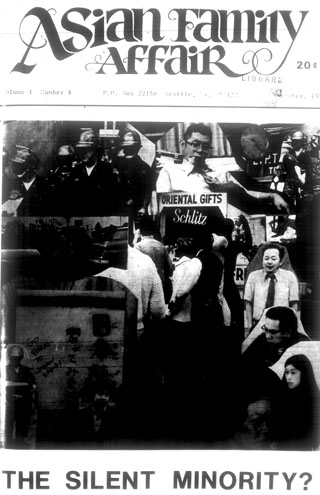
Through the Asian American movement, the term “Asian American” stuck and is still used today. The Asian American movement not only permanently implicated the word “Asian American”, but it also gave life to Asian Americans as a whole. As stated previously, Asian Americans 
Although the term “Asian American” brings a unity to the Asian race, each person’s definition of the term is unique, thus making the term “Asian American” a unique term that is ever changing and continuing to grow each day.
Sources:
http://depts.washington.edu/civilr/aa_intro.htm
http://en.wikipedia.org/wiki/Asian_american
And We're Moving On Up!
 Minoru Yamasaki is a Second Generation Japanese (Nisei) born in
Being on the East Coast, Minoru Yamasaki was spared from the internment camps and in 1945 was named chief of design at Smith Hinchman & Gryllis in 
He continued to design sleek and modern designs. He designed the new campus buildings and plazas in
Minoru Yamasaki is a part of Asian American pop culture because of his modern designs and fusion styles; he imprinted Asian on American culture. Many of the buildings that he designed can still be seen today, and even though they no longer exist, the twin towers will forever place Minoru Yamasaki in American history. Minoru Yamasaki was selected to design the towers over I. M. Pei, Philip Johnson, and Walter Gropius. Being selected over these three well known architects shows how he defied the stereotypes of Japanese at the time (i.e. Yellow Peril), getting out of the dark ages and bringing American architecture a step into a more modern era.

Sources:
http://www.historylink.org/index.cfm?DisplayPage=output.cfm&File_Id=5352
http://en.wikipedia.org/wiki/Minoru_Yamasaki
http://www.answers.com/topic/minoru-yamasaki
Nightly News With Connie Chung
Connie Chung, who doesn't remember that name? Her face is almost unforgettable...well, it was.
Connie Chung, birth name Constance Yu-Hwa Chung, was born on August 20, 1946 in
In 1976, Connie Chung moved to 
Later on she went back to CBS, hosted a show “Eye To Eye With Connie Chung”, but in 1995, Connie’s credibility was in jeopardy when the network gave her “tabloid” stories, and when she wanted more important stories, they fired her.
Connie Chung received many honors while on the air, including three National Emmy awards, a
Connie Chung can be considered an Asian American Pop Culture icon during the 1970s and 1980s be
Connie Chung paved the way for other Asian American anchors, which many can be seen today: Tritia Toyota, Lisa Ling and David Ono to name a few. So all we can say is thanks Connie, you helped keep Asian Americans in the limelight!
Sources:
http://www.answers.com/topic/connie-chung
http://en.wikipedia.org/wiki/Connie_Chung